

Your DPhil project will align with one of five core themes.
Each theme reflects BBSRC priorities in the biosciences and is shaped by ENAIBLE’s commitment to AI-first, data-intensive biological research.
ENAIBLE is designed for an AI-driven era of biology, sometimes described as Biology 2.0, in which computational systems are active partners in discovery, modelling and hypothesis generation.
Each theme draws on expertise across the partner institutions and is supported by supervisors from multiple disciplines.
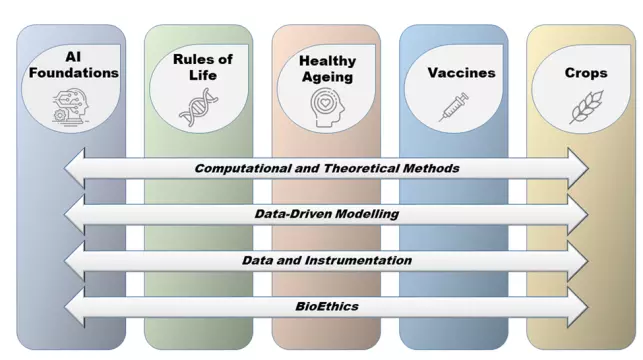
AI Foundations
This theme advances the mathematical and computational foundations required for AI-first bioscience. Research may include the development of new machine learning architectures, modelling frameworks and analytical approaches designed for structured, multimodal and high-dimensional biological data. The focus is on extending the theoretical and algorithmic basis of AI in ways that address the distinctive complexity, noise and scale of living systems.
Rules of Life
This theme investigates fundamental biological organisation across molecular, cellular and systems scales using AI-enabled modelling and data integration. Research may combine statistical inference, computational modelling and experimental data to illuminate regulatory processes, interaction networks and emergent biological behaviour. It reflects BBSRC’s emphasis on discovery science strengthened through quantitative and computational insight.
Healthy Ageing
This theme examines the biological mechanisms that shape ageing, resilience and functional change through AI-driven and data-intensive approaches. Research may integrate modelling with experimental and clinical data to characterise biological trajectories and identify drivers of health and decline. The emphasis is on computational methods that contribute to mechanistic understanding of ageing processes.
Vaccines
This theme supports AI-enabled approaches to immunology and vaccine-related bioscience. Research may involve modelling immune dynamics, analysing high-dimensional immunological datasets and developing predictive frameworks relevant to biological response. The aim is to strengthen foundational immunological understanding while supporting analytical capability relevant to vaccine-related biological processes.
Crops
This theme addresses plant and agricultural bioscience in the context of sustainability and environmental resilience. It draws on expertise at Aberystwyth University’s Institute of Biological, Environmental and Rural Sciences (IBERS). Research may include modelling plant systems, analysing genomic and phenotypic datasets and applying AI methodologies to biological processes central to crop development and adaptation. It aligns with BBSRC priorities in plant science and the bioeconomy.
Data, Instrumentation and Infrastructure
ENAIBLE builds on substantial research infrastructure across the partner institutions. You benefit from access to advanced computational environments, high-performance computing, large-scale biological datasets and state-of-the-art experimental platforms, including genomics, imaging and high-throughput technologies.
This integration of data, instrumentation and modelling capability is central to the programme’s design. AI methods are developed and tested in direct engagement with real biological systems and experimental contexts.
Ethics and Responsible AI
A defining feature of ENAIBLE is its integration of bioethics and responsible research throughout the training and research lifecycle. The programme reflects the emphasis on responsible and ethical applications of AI in biosciences set out in the grant.
You will engage with ethical governance, research integrity and the societal implications of AI-driven bioscience as part of both formal training and doctoral research. Ethical reflection is embedded in the programme’s intellectual framework.